
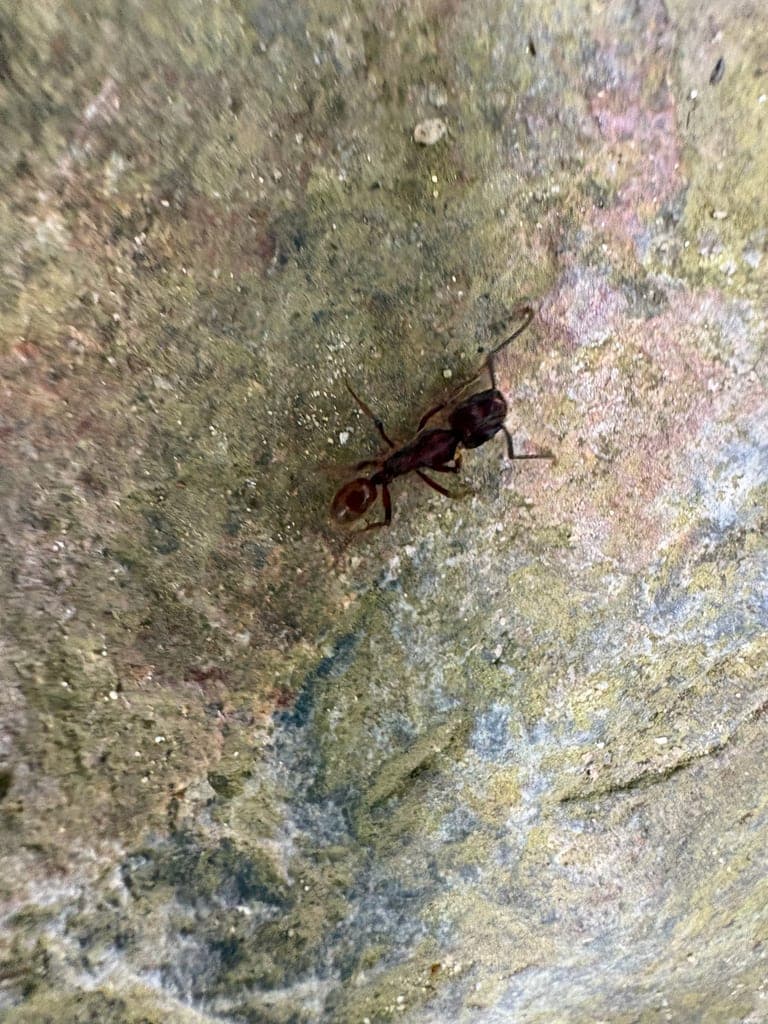
 Live photo
Species & care sheets
Tooth Ant
Odontoponera transversa · มดไอ้ชื่นมลายู
Overview
Temperature
25–30°C
Humidity
70–90%
Diet
Sugar · Insects
Nest type
Soil / Ytong / gypsum
Growth
Slow
Colony size
50–300 ตัว
- Difficulty — เป็นมดตั้งรังแบบ Semi-claustral ที่ต้องการอาหารสดอย่างสม่ำเสมอ และมีเหล็กในที่ต่อยเจ็บมาก
- Colony size — รังขนาดใหญ่ในธรรมชาติมักมีสมาชิกไม่เกินหลักร้อยตัว
- How often it is found — มีข้อมูลบันทึกพบค่อนข้างมาก เจอได้ไม่ยากนัก — มีบันทึกยืนยันพบในไทยโดยตรงด้วย; มีวางขายในตลาดนักเลี้ยงมดต่างประเทศ (มีสต๊อกจริง) · Records in Thailand 8 · Records worldwide 289 · Hobbyist market: Sold abroad
Derived from record counts in global databases (GBIF · AntWeb · iNaturalist), not from how common the ant is in Thailand. — น่าเชื่อถือสูง — มีบันทึกพิกัด/ตัวอย่างในไทยจริง (GBIF/AntWeb)
What it eats
Size
Body length by caste, and the ants drawn to scale on a credit card
Actual size against a credit card
Ants are drawn to scale on a standard card (85.6 × 54 mm) — hold a real card against the screen and move the slider until the card matches, and the ants are then life-size.
~10.5 mm
~12 mm
Behaviour & care
Defences
AggressiveAttacks when disturbed — handle with care.
Colony profile
Queens
Either
Founding
Semi-claustral
Diapause
Not required
Growth
Slow
In depth
The Tooth Ant (Odontoponera transversa), known in Thai as "มดไอ้ชื่นมลายู," is a medium-sized ground ant commonly found in gardens and farmland across Thailand. Its defining feature is a row of small teeth along the jaw and thorax margins — the source of the genus name Odontoponera, meaning "toothed Ponera."
Appearance
Workers measure 9–12 mm, while winged queens are slightly larger at 11–13 mm. Body color ranges from deep red to black. The mandibles are short but strong, and the legs are relatively short for the body size. The front edge of the clypeus is finely toothed, and the front margin of the pronotum (thorax) is toothed as well — the key features that distinguish this genus from other ground ants.
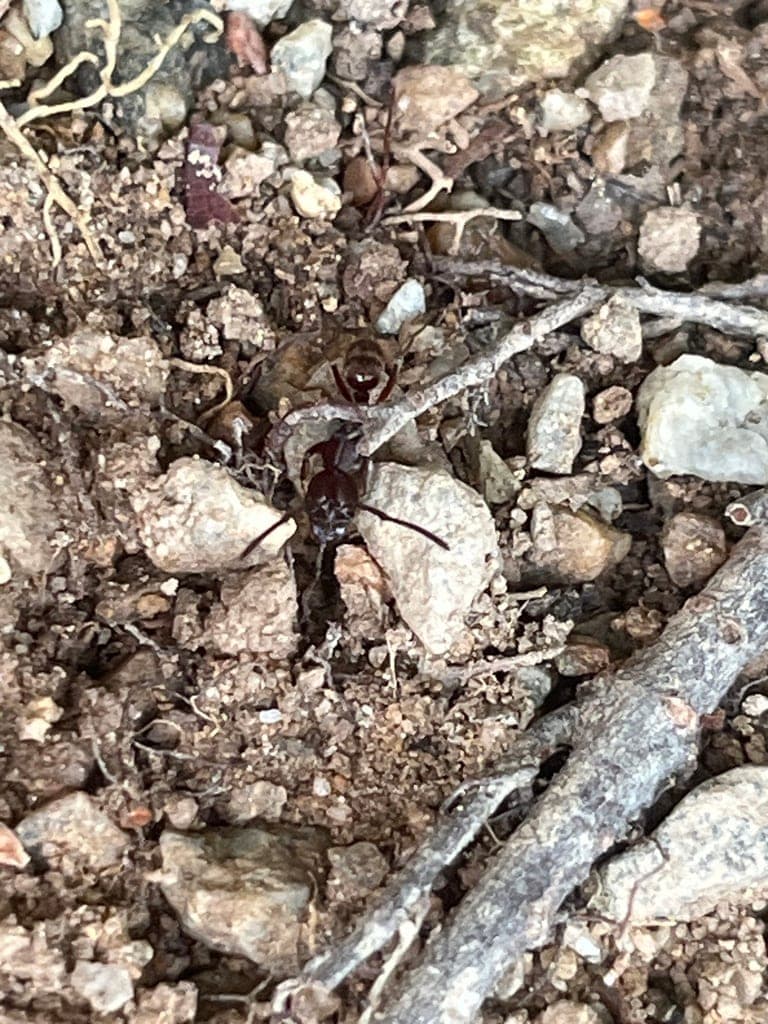
Photo © Animotions · CC BY-NC
Where They're Found
Widely distributed across South and Southeast Asia, from Pakistan to the Philippines, and from southern China down to the southern islands of Indonesia — including India, Bangladesh, Myanmar, Thailand, Malaysia, Indonesia, and Vietnam. It's a ground-dwelling forager that favors forested or shaded areas with moist soil. Nests are underground burrows with a circular entrance 3.5–5 mm wide, containing horizontal chambers stacked at different depths — upper chambers around 10–36 cm deep, with the deepest chambers reaching nearly 60 cm. The queen and larvae stay in the deepest chambers, while workers occupy the upper levels.
This is a fairly tough, easy-to-keep species compared to most predatory ants. The main challenge is maintaining consistently high humidity, since it naturally nests deep in moist soil — provide a generous substrate layer or burrowing material to mimic its natural multi-level nest structure. The colony size figure given here (50–300 workers) reflects what's commonly seen, not a maximum.
Good to Know
The genus name Odontoponera combines the Greek odonto- ("tooth") with the genus Ponera, a large group of predatory ants, meaning "toothed Ponera" — a direct reference to the small teeth along its clypeus and thorax margins. The genus contains just two species, O. denticulata and O. transversa, both locally abundant within their respective ranges.
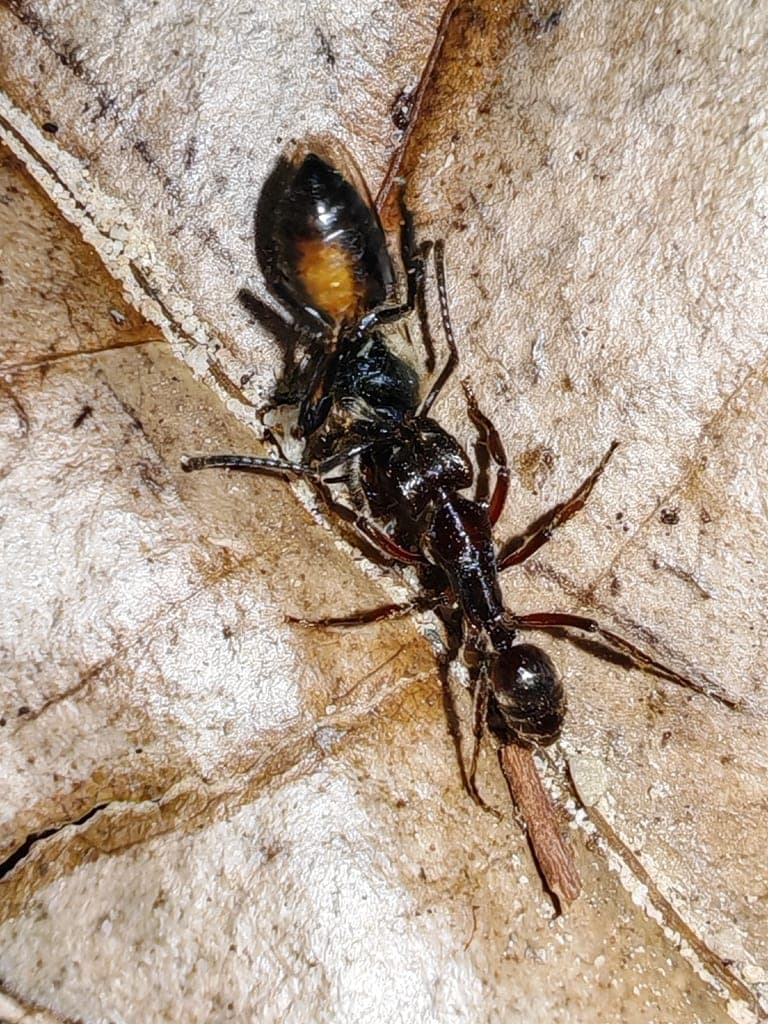
Photo © Zhenlong Dai · CC BY-NC
Behavior: A Multi-Story Underground Termite Hunter
Odontoponera transversa builds its nest as a series of stacked horizontal chambers deep in the soil, with the queen kept safest in the deepest chamber while workers spread out through the shallower ones on defense.
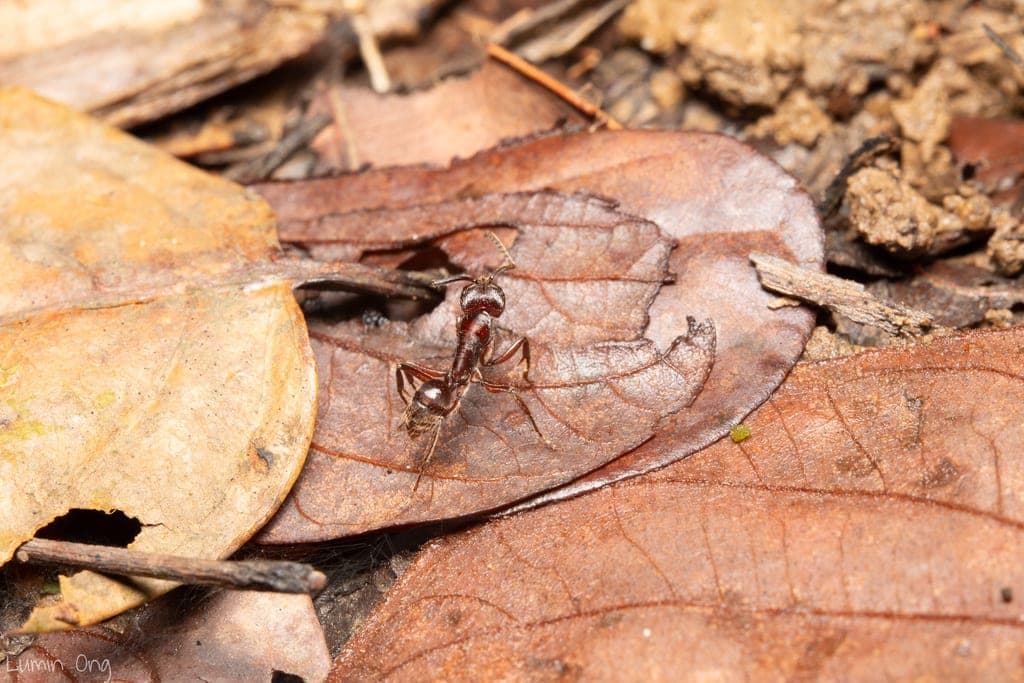
It's a generalist predator and scavenger with a particular fondness for termites, foraging over a meter from the nest and hunting mostly soft-bodied insects. This multi-level nest structure lets each caste occupy its own zone efficiently, while also offering some protection from predators and surface flooding.
Keeping Them in Captivity
A flexible eater that both hunts and scavenges. Crushed fruit flies, small pre-killed crickets, or roaches all work well. Ideal temperature is above 25°C, though it stays active down to about 18°C — it shouldn't be kept at low temperatures for long, though. Humidity should be 70–90%, reflecting its naturally deep, moist nesting habit. Colonies usually have one or a few queens, though polygyny (multiple queens) has been observed in some cases.
Gallery
Photo © Animotions · CC BY-NC
Photo © Zhenlong Dai · CC BY-NC
Photo © Bingle Berry · CC BY-NC
Photo © Jonghyun Park · CC BY
Photo © Jonghyun Park · CC BY
Photo © Jonghyun Park · CC BY
Live photographs are by iNaturalist observers under CC BY-NC — every one carries its credit.
Sources
The Thai text is written from the facts in these sources, not copied from them. · Data confidence: สูง
This page is husbandry information only — live ants aren't sold on the site, for the animals' safety in transit.