
 Live photo
Species & care sheets
Giant Jumping Ant
Harpegnathos venator · มดเขี้ยวโง้ง
Visual hunters that leap at prey. Tiny colonies where every worker is a predator — for experienced keepers.
สกุล Harpegnathos จัดเป็นมดในวงศ์ย่อย Ponerinae มีคุณสมบัติเด่นคือมดงานสามารถพัฒนาเป็น Gamergate ได้
Overview
Temperature
24–28°C
Humidity
70–85%
Diet
Sugar · Insects
Nest type
Soil / Ytong / Plaster
Growth
Slow
Colony size
100–300 ตัว
- Difficulty — ต้องการเหยื่อมีชีวิตเท่านั้น ความชื้นสูง และเสี่ยงต่อการติดเชื้อราได้ง่ายหากจัดการรังไม่ดี
- Colony size — ขนาดรังค่อนข้างเล็ก ไม่เกินประมาณ 400 ตัวเนื่องจากข้อจำกัดทางสังคมของมดกลุ่มนี้
- How often it is found — มีข้อมูลบันทึกพบค่อนข้างมาก เจอได้ไม่ยากนัก — มีบันทึกยืนยันพบในไทยโดยตรงด้วย; มีวางขายในตลาดนักเลี้ยงมดต่างประเทศ (มีสต๊อกจริง) · Records in Thailand 3 · Records worldwide 458 · Hobbyist market: Sold abroad
Derived from record counts in global databases (GBIF · AntWeb · iNaturalist), not from how common the ant is in Thailand. — น่าเชื่อถือสูง — มีบันทึกพิกัด/ตัวอย่างในไทยจริง (GBIF/AntWeb)
What it eats
Size
Body length by caste, and the ants drawn to scale on a credit card
Actual size against a credit card
Ants are drawn to scale on a standard card (85.6 × 54 mm) — hold a real card against the screen and move the slider until the card matches, and the ants are then life-size.
~15.5 mm
~17 mm
Behaviour & care
Defences
AggressiveAttacks when disturbed — handle with care.
Colony profile
Queens
Either
Founding
Semi-claustral
Diapause
Not required
Growth
Slow
In depth
The Giant Jumping Ant (Harpegnathos venator), known in Thai as "มดเขี้ยวโง้ง" (curved-fang ant), is a predator with unusually large eyes for an ant, hunting by sight rather than scent. Its signature trait — and the reason it's famous among ant keepers — is its ability to jump, both to catch prey and to escape danger.
Appearance
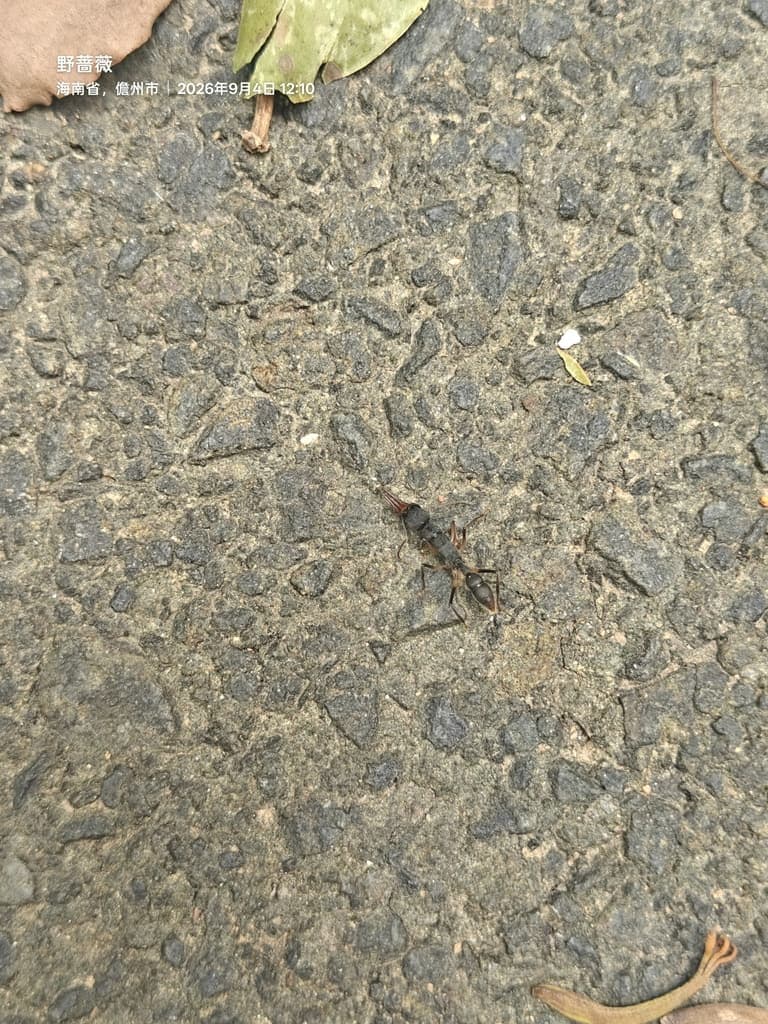
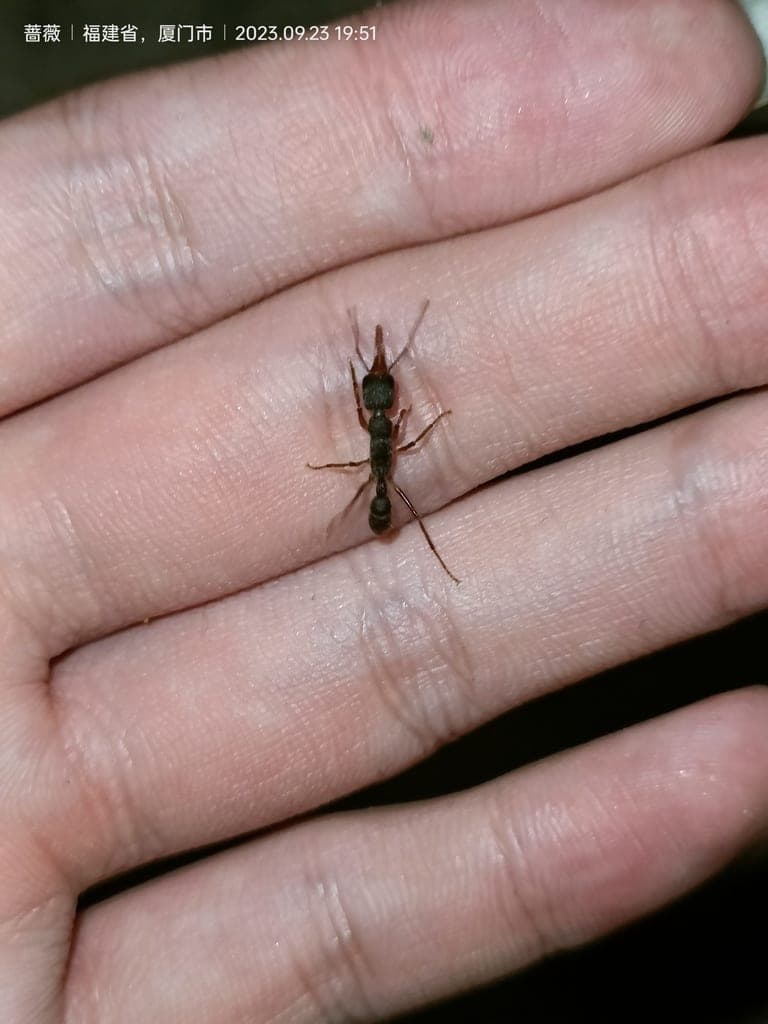
The body is matt black, with distinctively long, curved mandibles (the source of its Thai name, "curved fang"). Workers show brownish-yellow coloring on the mandibles, cheeks, and legs, with a rust-toned abdomen tip. The most noticeable feature is its unusually large eyes, giving it sharper vision than most ants, which rely mainly on scent. Queens look almost identical to workers, differing only in a slightly larger thorax and developed ovaries.
Where They're Found
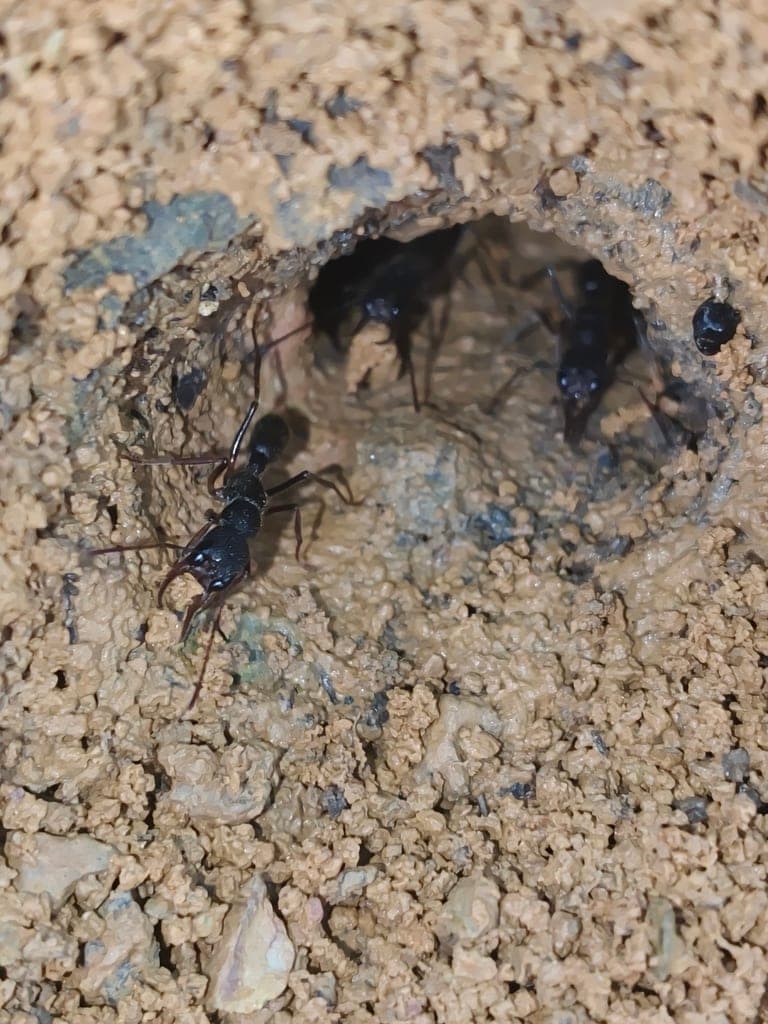
Found across South and Southeast Asia, particularly northern India and Burma, living in the shade of forest understory. Colonies nest in sloped earth, with a small entrance leading to several disc-shaped chambers connected by narrow passages just wide enough for a single ant to pass through. The uppermost chamber houses the queen and workers. Colonies stay relatively small compared to other ants, since this predator needs a fairly large foraging territory per individual.
It isn't aggressive in the sense of chasing you down, but its sting is genuinely powerful — comparable to a hornet's — and can ache for hours, so care is needed whenever the nest is opened or ants are moved. The colony also grows slowly and needs a steady supply of fresh prey at all times. The colony size figure given here (100–300 workers) reflects a typical mature colony, not a maximum. Better suited to keepers with some prior experience than to total beginners.
Good to Know
Workers can lay unfertilized trophic eggs purely as food for the colony's reproductive, a behavior seen in several ant genera with unusual reproductive systems. The English common name "Giant Jumping Ant" comes directly from its standout jumping behavior, which makes it easy to distinguish from other predatory ants at a glance.
It isn't aggressive in the sense of chasing you down, but its sting is genuinely powerful — comparable to a hornet's — and can ache for hours, so care is needed whenever the nest is opened or ants are moved. The colony also grows slowly and needs a steady supply of fresh prey at all times. The colony size figure given here (100–300 workers) reflects a typical mature colony, not a maximum. Better suited to keepers with some prior experience than to total beginners.
Good to Know
Workers can lay unfertilized trophic eggs purely as food for the colony's reproductive, a behavior seen in several ant genera with unusual reproductive systems. The English common name "Giant Jumping Ant" comes directly from its standout jumping behavior, which makes it easy to distinguish from other predatory ants at a glance.
Behavior: Hunting by Sight and by Jumping
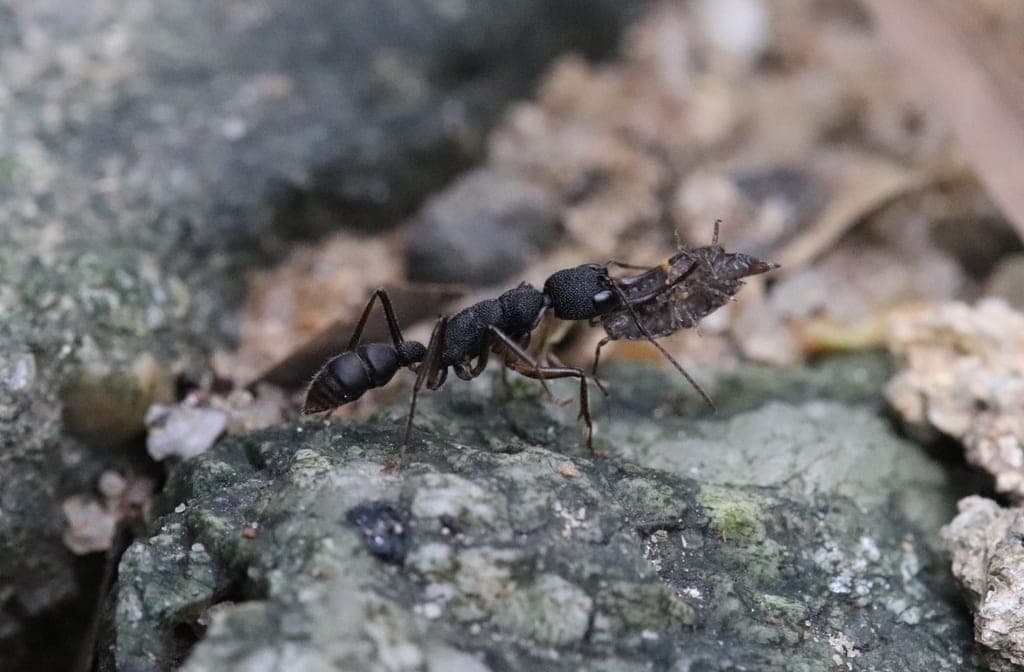
Harpegnathos venator jumps both to capture prey and to escape predators, relying on unusually large, sharp eyes rather than scent trails like most ants.
Its mandibles have region-specific structure: the tips carry double rows of non-parallel teeth for a powerful, clamping grip on prey, while the base is smoothly concave, built for gently handling larvae and eggs without harming them. When the queen dies, workers compete through ritualized "antennal duels" to determine which one becomes the new reproductive gamergate. The winner can only produce viable worker offspring if she mated with a male before establishing her dominance.
Keeping Them in Captivity
An almost exclusive predator that rarely touches sugar water or seeds. Its diet should be live or freshly killed insects — crickets, mealworms, roaches. Ideal temperature is around 24–28°C in the nest and 26–30°C in the foraging area; sustained temperatures above 32°C can damage the brood. Humidity should stay around 70–85%. Colony growth is very slow — typically just 40–80 workers in the first year, taking 3–5 years to reach the low hundreds.
Gallery
Live photographs are by iNaturalist observers under CC BY-NC — every one carries its credit.
Sources
The Thai text is written from the facts in these sources, not copied from them. · Data confidence: สูง
This page is husbandry information only — live ants aren't sold on the site, for the animals' safety in transit.